

Imagine having a remote co-pilot for your business. Someone who isn't in the office next to you, but is a skilled, independent professional dedicated to managing crucial tasks from afar. That’s a virtual assistant. They handle the operational details so you can focus on steering the ship.
What a Virtual Assistant Really Is (And Isn't)

If you hear "virtual assistant" and immediately think of a glorified data entry clerk, it's time for an update. That idea is years out of date. Today’s VA is a strategic partner, an indispensable asset who has evolved far beyond basic admin work.
For founders and busy executives, a great VA is the secret weapon for getting back their most valuable resource: time. Instead of drowning in "operational drag"—all those day-to-day tasks that eat up the clock but don't move the needle on revenue—you can hand them off. This move frees you up to pour your energy into what really matters, like strategy, big-picture thinking, and building client relationships.
The Modern Evolution of Remote Support
The virtual assistant market isn't just growing; it's exploding. What was once a niche service is now a global industry projected to hit anywhere from USD 8.17 billion to USD 25.63 billion by 2025.
What’s driving this boom? It's simple: businesses are chasing efficiency. Hiring a VA can slash operational costs by as much as 78%. For a deeper dive into these numbers, check out the VA market growth analysis on Startus Insights.
Bringing a VA on board is more than just outsourcing a to-do list; it’s about building a system for getting things done right. They offer a flexible, scalable way to get the help you need without the financial and logistical baggage of a full-time, in-house employee.
A virtual assistant isn't just another person on the payroll. They are a strategic investment in your own productivity, giving you the leverage to focus on what truly drives business growth.
This is a fundamental shift in how you work. It allows you to break free from the "busy" trap and become a more effective leader. When you offload those critical but time-sucking functions, you create the breathing room and mental space needed for real innovation and long-term planning. That’s how you set your business up for sustainable success.
What Tasks Can You Actually Delegate to a VA?

It’s one thing to understand the idea of a virtual assistant, but it’s another to know exactly what you can, and should, hand off your plate. The truth is, the possibilities are way bigger than most people realize, going far beyond just basic admin work.
The best place to start? Look at the bottlenecks in your own day. Where do you get stuck? What repetitive tasks eat up your time but don't actually grow the business?
Think of a VA as a flexible extension of your team, ready to plug the gaps wherever you need them most. To make this less abstract and more actionable, let’s look at the most common types of tasks you can confidently delegate.
Common Virtual Assistant Task Categories
To help you visualize where a VA could fit into your business, here’s a breakdown of the typical buckets of work they handle and the direct impact you'll see.
| Task Category | Example Tasks | Impact on Your Business |
|---|---|---|
| Administrative Support | Inbox/calendar management, data entry, travel planning, appointment scheduling, file organization. | Frees up your time from day-to-day operational drag, allowing you to focus on strategy and growth. |
| Marketing & Creative | Social media scheduling, creating graphics in Canva, basic video editing, drafting newsletters, blog post formatting. | Creates a consistent, professional brand presence online without you needing to be a designer or marketer. |
| Technical & Web | Basic website updates (WordPress), managing customer support tickets, setting up webinars, CRM management. | Keeps your digital infrastructure running smoothly and ensures your customers feel supported. |
| Sales & Client Support | Qualifying leads, customer onboarding, managing client communications, preparing proposals. | Improves the client experience and keeps your sales pipeline moving, even when you're busy. |
This is just a starting point. A great VA often grows with you, taking on more complex responsibilities as they learn your business inside and out.
Administrative and Operational Support
This is the bread and butter of virtual assistance and often where new clients see the most immediate ROI. These are the tasks that keep the lights on but can easily swallow your entire morning if you’re not careful. A VA brings order to the chaos.
Some of the heaviest hitters in this category include:
- Inbox and Calendar Management: Imagine your inbox being perfectly organized and your calendar intelligently scheduled for you. A VA filters the noise, responds to routine requests, and protects your time.
- Data Entry and Management: From updating your CRM to organizing messy spreadsheets, this ensures your business data is actually useful instead of just a jumble of numbers.
- Travel and Event Coordination: Booking flights, hotels, and coordinating all the little details for a business trip or team event? Done.
By offloading these foundational tasks, you’re not just buying back time; you're buying back mental energy. This allows you to focus on the high-value work that only you can do.
Creative and Marketing Assistance
You don't need a full-time marketing hire to build a professional online presence. Many VAs have a creative streak and specific skills in digital marketing, giving you agency-level support without the agency price tag.
A skilled virtual assistant doesn't just complete tasks; they actively look for ways to improve processes. By managing your foundational operations, they create the stability needed for you to innovate and grow.
This could mean designing your social media graphics, doing simple video edits for TikTok or Instagram Reels, or even drafting your weekly newsletter. For more ideas, check out our guide on 10 things to outsource to a virtual assistant that might surprise you.
Technical and Client-Facing Roles
Beyond the back-end work, a VA can step into crucial roles that directly impact your customers and your digital storefront. This is where they shift from a simple helper to a true partner in your business.
Think about tasks like:
- Customer Service: Acting as the first line of defense for support tickets, answering common questions, and onboarding new clients so they feel taken care of from day one.
- Website Maintenance: Handling basic updates on your WordPress site, uploading new blog posts, or making sure plugins and themes are current.
- Social Media Management: Not just posting content, but actively engaging with your community by responding to comments and messages.
When you delegate these jobs, you ensure your customers and your online presence are never neglected. That consistent, reliable engagement is exactly what builds trust and turns followers into loyal fans.
The Strategic Value of Hiring a Virtual Assistant
Thinking of hiring a virtual assistant as just another expense is missing the point entirely. It's not about offloading tasks; it's a powerful strategic investment that fundamentally changes how you work and paves the way for serious growth.
This is especially true for small and medium-sized businesses (SMBs), which are fueling the explosive growth in the VA world. The global market for virtual assistants is on track to hit a staggering USD 19,506.2 million by 2025. And who's leading that charge? SMBs, making up over 50.2% of that demand. For these businesses, VAs are the key to unlocking top-tier talent without the crushing overhead of a full-time employee. You can get a deeper look at these virtual assistant industry trends on Wishup.co.
Reclaiming Your Most Valuable Asset
If you're an entrepreneur, you know the feeling. You're buried under a mountain of administrative tasks—emails, scheduling, social media updates, data entry. You're stuck working in your business instead of on it.
Imagine a small e-commerce owner who was spending most of her day just keeping the lights on. She was answering customer inquiries, tweaking product descriptions, and responding to every social media comment. Then, she hired a VA. Suddenly, all those daily operational tasks were off her plate. She could finally focus on what really mattered: designing new products and forging relationships with suppliers. In just six months, her revenue doubled. It wasn't because she worked harder; it was because she started working smarter.
A virtual assistant acts as a strategic lever, freeing up your time and mental energy to concentrate on high-impact activities that only you can do. It's about delegating the urgent to focus on the important.
The True Cost Savings of a VA
The financial benefits are often the first thing people notice, and for good reason. A VA helps you sidestep the hefty costs that come with a traditional hire, which can be a massive barrier for a growing business.
When you bring on a VA, you're not on the hook for a long list of expensive commitments.
- No Employee Benefits: Forget about navigating health insurance, retirement plans, or paid time off.
- Zero Overhead: There’s no need to pay for an extra desk, office space, or a higher utility bill.
- Equipment Provided: VAs come with their own gear—laptops, software, the works. You don't have to worry about a thing.
This lean model gives you on-demand access to specialized skills, from digital marketing to bookkeeping, without locking you into a full-time salary. You pay only for productive hours. It’s a flexible, cost-effective way to scale. To get a better sense of their impact, check out our article on the top reasons why you need a virtual assistant. This kind of agility can be a complete game-changer.
Alright, let’s unpack the different ways you can bring a virtual assistant onto your team. Once you’ve decided you need a VA, the very next question is, "Okay, so where do I actually find one?" How you answer that question will shape your entire experience, from the hiring process to your daily workflow.
There's no single "best" way to hire—it really depends on what you need and how you like to work. Let's break down the three main paths you can take: hiring a freelancer directly, going through a big agency, or working with a dedicated managed service. Each has its own vibe, with unique pros and cons.
Going the Independent Freelancer Route
This is the classic DIY approach. You hop onto a platform like Upwork or search on LinkedIn, post a job description, and wait for the applications to roll in. The big draw here is the direct connection you build with your assistant and the freedom to set your own terms.
On the one hand, you have total control. You can hunt for someone with a very niche skill set and negotiate a rate that works for you. On the other hand… well, everything is on you.
- You're the Recruiter: You’ll be the one sifting through dozens (or hundreds) of applications, checking references, and figuring out if their skills are legit.
- You're the Trainer: Getting them up to speed is your responsibility. That means creating the training plan, documenting all your processes, and teaching them your systems from the ground up.
- You're the Manager: All the day-to-day oversight, feedback, and troubleshooting falls squarely on your shoulders.
- You Have No Backup Plan: What happens if your VA gets sick, takes a vacation, or just disappears? You’re stuck, often forced to start the entire hiring process all over again.
This path is a great fit for entrepreneurs who genuinely have the time and experience to manage a full hiring cycle and can provide consistent, hands-on direction.
The Large Agency Model
Think of large VA agencies as massive talent marketplaces. Their main selling point is access to a huge pool of assistants. They handle the basic HR paperwork and payroll, which can take some administrative weight off your plate.
The catch? It can feel a bit like a numbers game. You might be assigned an assistant with very little say in the matter, and that person might not be the right personality or cultural fit for how you work. You get access to talent, sure, but whether it’s the right talent often feels like a roll of the dice. The deep, strategic match is often missing from the equation.
Choosing a hiring model isn't just about finding a person; it's about finding a system. The right system reduces your workload, provides support, and ensures continuity, while the wrong one can create more management headaches than it solves.
The Dedicated Managed Service
A managed service, which is the model we’ve perfected at Match My Assistant, is designed to be the best of both worlds. It gives you the dedicated, personal feel of a direct hire without the massive time commitment and risk that comes with finding someone on your own.
Instead of just handing you a list of candidates, we provide a complete support system. Here’s what that actually looks like:
- Curated Matching: We don't just look at resumes. We dig deep to understand your business, your work style, and even your personality to find the perfect match, not just the next available person.
- Pre-Vetted Talent: Every assistant in our network has already been through a rigorous vetting process. They’re skilled, professional, and ready to contribute from day one, which saves you countless hours of screening.
- Structured Onboarding and Support: We don't just make an introduction and walk away. We help guide the onboarding process and provide continuous support for both you and your VA to make sure the relationship is successful for the long haul.
This "done-with-you" approach is ideal for busy founders and executives who need the leverage a top-tier assistant provides but can't afford to get bogged down in a lengthy and risky hiring process. It's the perfect mix of personalized support and professional oversight.
Comparing VA Hiring Models
To make it even clearer, here’s a quick side-by-side look at how these three models stack up. Think about your own schedule, budget, and management style as you review the options.
| Hiring Model | Pros | Cons | Best For |
|---|---|---|---|
| Freelancer | Total control over hiring, direct relationship, potentially lower cost. | Time-consuming hiring process, all management falls on you, no backup or support. | Hands-on business owners with the time and experience to manage recruitment and training directly. |
| Agency | Large talent pool, basic admin (payroll, etc.) is handled, quick placement. | Often impersonal, high turnover, matchmaking can be a gamble, less control over selection. | Companies needing to fill a role quickly and are willing to trade a perfect fit for speed. |
| Managed Service | In-depth matchmaking, pre-vetted talent, ongoing support, backup assistants available. | Higher investment than direct freelancers, more structured process. | Busy professionals who value a long-term, strategic partnership and want to minimize hiring risks. |
Ultimately, the goal is to find a solution that not only gets tasks off your plate but also gives you peace of mind. The right model makes you feel supported, not like you’ve just taken on a second job as a recruiter and manager.
A Practical Guide to Hiring and Onboarding Your First VA
Bringing a virtual assistant on board is more than just posting a job ad and hoping for the best. If you want it to succeed, you need a plan. A thoughtful hiring and onboarding process is what separates a game-changing partnership from a frustrating false start.
Think of it like building a bridge. You're creating a clear path for your new VA to join your business, get up to speed, and start making a real impact, fast.
The groundwork starts long before you even look at a single application. The most important first step? A personal time audit. For one full week, jot down every single task you do, from answering emails to planning strategy. Then, sort them. What’s repetitive? What drains your energy but doesn't really need your personal touch? Those are the perfect tasks to hand off.
Once you know what you want to delegate, you need to document how it gets done. Don't overthink this. A quick screen recording walking through a process or a simple numbered checklist is often all you need. These become your Standard Operating Procedures (SOPs), the training manual that helps your VA nail it from day one.
Vetting and Onboarding for Success
With your tasks identified and your processes mapped out, you’re ready to start looking for the right person. When it comes to interviews, go beyond their resume. You want to see how they think, so ask questions that reveal their problem-solving skills and how they communicate.
You could try asking things like:
- "Walk me through a time you had to juggle multiple urgent deadlines. How did you decide what to tackle first?"
- "If I gave you a task but the instructions were a bit vague, what would you do next?"
- "What project management and communication tools, like Slack or Asana, have you used before?"
This flowchart breaks down the different routes you can take when hiring.
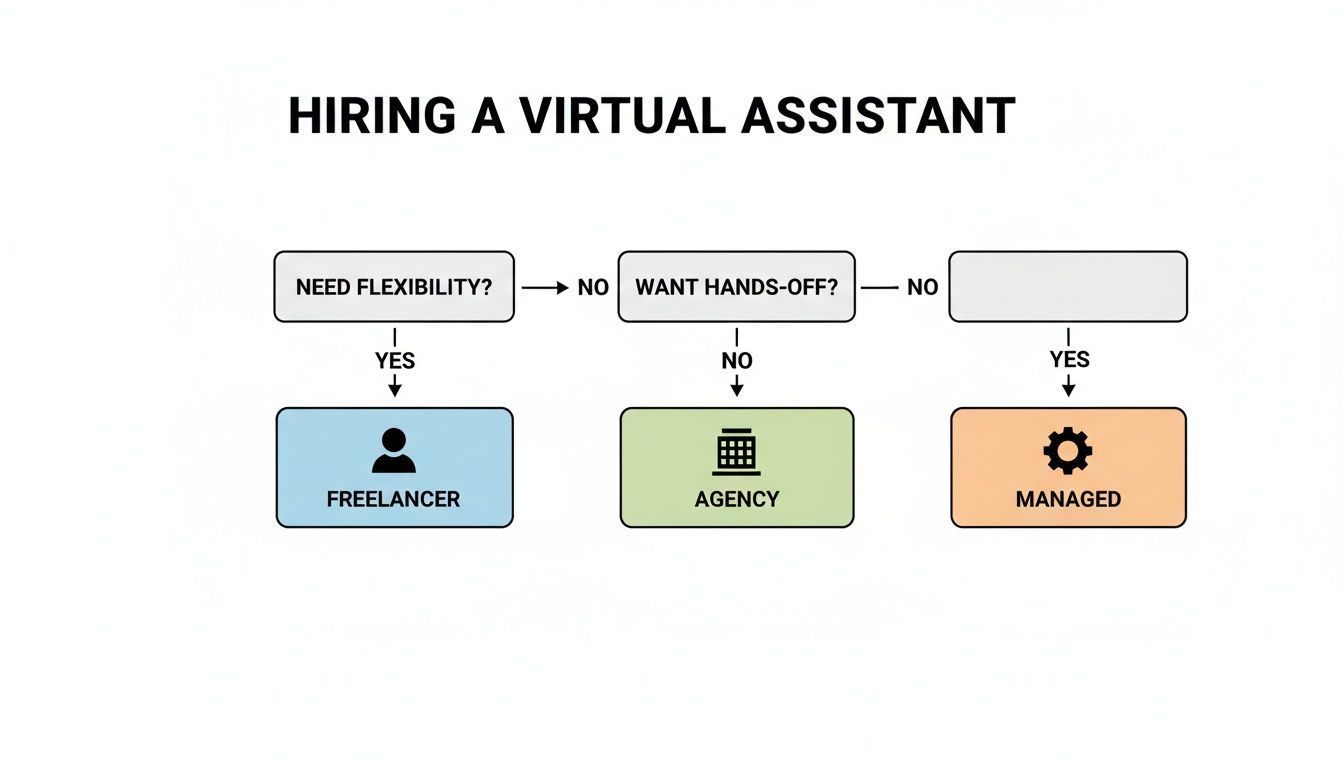
As you can see, the right path often depends on how much time you can personally invest in management versus how much you need a system that has support already built in.
After you've found your ideal candidate, the real work begins. Don't make the classic mistake of just sending over a list of tasks and expecting miracles. The onboarding phase is where the foundation for long-term success is laid.
A successful onboarding isn't a one-day data dump; it's a 30-day process. The goal is to build real trust, set crystal-clear expectations, and find a communication rhythm that works for both of you.
Map out a structured 30-day plan. Week one should be all about getting them access to your systems, introducing them to the team (if you have one), and letting them master one or two key tasks. From there, you can slowly add more responsibility, making sure to schedule quick daily check-ins to answer questions and offer feedback.
If you want to dive deeper, check out these three basics to hire and train a virtual assistant. Taking this proactive approach is what turns a new hire into a truly integrated team member who delivers incredible value right from the start.
Still on the Fence? Let's Tackle Those Lingering VA Questions
Even after seeing all the benefits laid out, it's totally normal to have a few nagging questions. I get it. Bringing someone new into your business, even remotely, is a big step.
Let's walk through some of the most common concerns I hear from business owners who are thinking about hiring a virtual assistant.
"How do I keep my business information safe?"
This is probably the biggest—and most important—question people have. Handing over the keys to the kingdom can feel daunting, but there are simple, ironclad ways to protect your sensitive data.
First, a non-disclosure agreement (NDA) is non-negotiable. It's a standard business practice that sets clear legal expectations for confidentiality. Second, never, ever email a password. Instead, use a secure password manager like LastPass or 1Password. These tools let you grant access to specific accounts without ever revealing the actual login credentials. Your VA gets the access they need, and you keep total control.
"What about the time zone difference?"
Many people see a different time zone as a roadblock, but I see it as a secret weapon. Think about it: while you’re offline for the night, your VA can be powering through tasks.
Imagine waking up to an inbox that's already been sorted, a report that's ready for your review, or customer inquiries that have already been handled. A VA in a different time zone can literally keep your business productive 24/7. It turns the clock into a competitive advantage.
"Is a VA just a human version of an AI tool?"
This is a great question, especially with all the buzz around AI. But the two are worlds apart.
The powerful difference between a virtual assistant and an AI tool is human intuition. While AI can automate tasks, a VA provides strategic thought, anticipates needs, and offers creative problem-solving that software simply can't replicate.
An AI is a tool—it follows commands and automates repetitive functions. A human virtual assistant, on the other hand, is a partner. They can think critically, manage complex projects with nuance, adapt on the fly, and understand the unwritten rules of your business. They don't just do tasks; they think about how to do them better.
Ready to reclaim your time and focus on what truly matters? The team at Match My Assistant specializes in pairing busy professionals with top-tier, vetted virtual assistants. We handle the matching, so you can get back to growing your business. Find your perfect assistant today.