

The most effective way to hire a VA in the Philippines is to partner with a managed virtual assistant agency. This approach saves you weeks of vetting and onboarding, connecting you directly with a skilled professional ready to integrate into your business. The result is immediate: you reclaim hours, reduce context switching, and ensure critical administrative work is handled consistently without the churn of random freelancers. If you’re a founder or operator drowning in your inbox while trying to grow your business, this guide is for you.
Summary (TL;DR)
- What to do first: Partner with a managed service like Match My Assistant to skip the risks of freelance marketplaces and get a vetted, reliable assistant.
- What to delegate: Start with 3–5 high-volume, low-risk tasks like inbox management, scheduling, data entry, or social media posting.
- What to expect: Gain access to highly proficient English-speaking talent with a strong work ethic, all at a cost-effective rate that delivers immediate ROI.
- Common pitfalls: Avoid vague instructions, poor security habits like sharing primary passwords, and inconsistent communication. Clarity is key.
- Quick timeline: Plan for a 1–2 week onboarding period to get your VA settled, trained on initial tasks, and operating with confidence.
Key Takeaways
- Go with a Managed Agency: A virtual assistant agency eliminates the guesswork and risk of hiring, providing pre-vetted professionals and a satisfaction guarantee.
- Start with Simple Tasks: Identify 3-5 routine, time-consuming tasks to delegate first. This builds momentum and establishes a workflow.
- Prioritize Security: Never share primary passwords. Use a password manager and the principle of least privilege to grant access securely.
- Document Everything: Use templates for task briefs and Standard Operating Procedures (SOPs) to ensure clarity and consistent results.
- Establish a Cadence: Set up a rhythm for communication, like a quick daily async check-in and a 15-minute weekly sync call, to stay aligned.
- Measure ROI: Track hours saved and task quality to quantify the value your VA brings, turning delegation into a strategic advantage.
Quick Answers
What tasks should I delegate first?
Start with repeatable, low-risk tasks like inbox filtering, calendar management, and data entry to build trust and momentum.
How do I give access securely?
Use a password manager like LastPass or 1Password to share credentials without revealing the actual passwords, and grant role-based access to tools.
How long does onboarding take?
A structured onboarding typically takes 1–2 weeks for a VA to get comfortable with your tools and core tasks.
Step-by-Step Playbook
Bringing a VA from the Philippines onto your team is a process, not a single event. A methodical approach ensures a smooth transition and sets the foundation for a long-term, successful partnership. Follow this playbook to integrate your new assistant effectively.
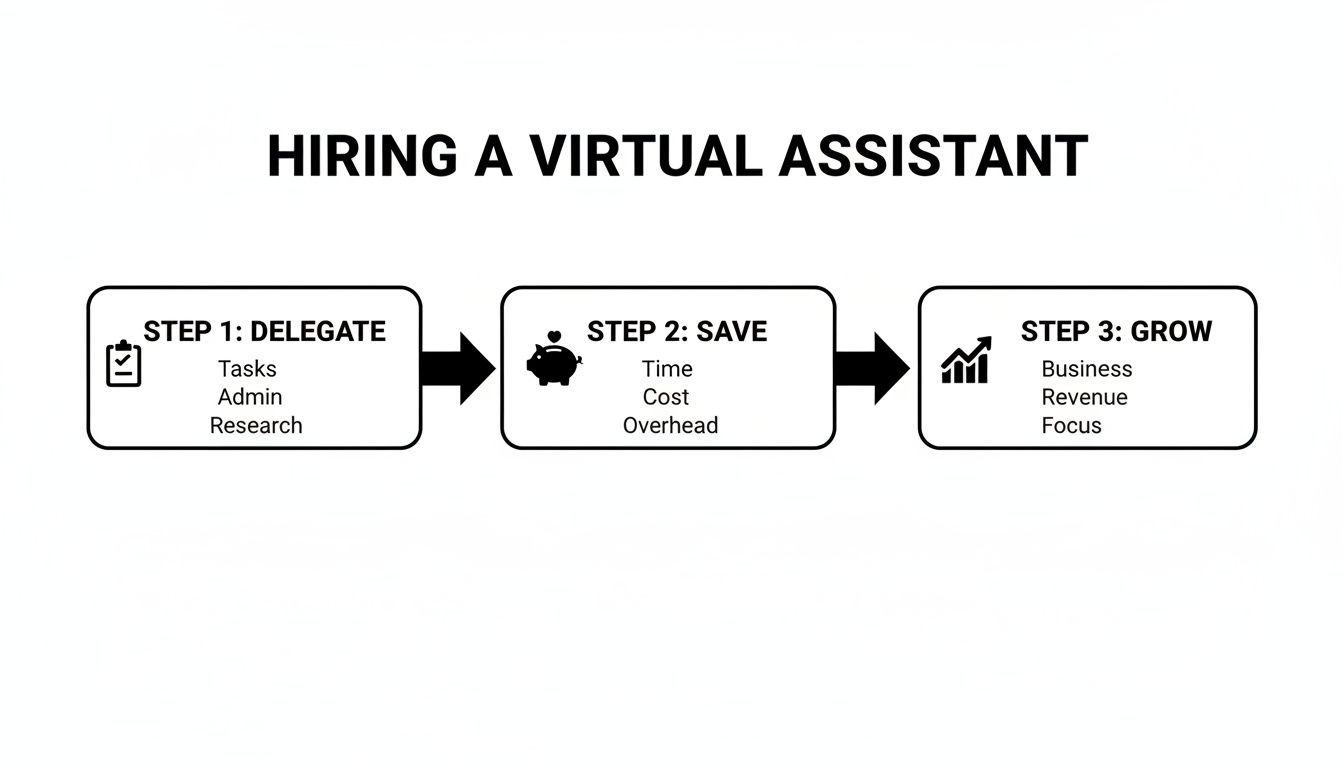
- Task Selection → Identify Your Delegation Priorities: Before you do anything else, identify 3–5 high-volume, low-complexity tasks that consume your time. Good candidates are inbox management, scheduling, or CRM data cleanup.
- Task Briefing → Create Crystal-Clear Instructions: For each task, create a simple brief outlining the goal, the "definition of done," and any necessary resources. Vague instructions are the primary cause of rework.
- Access & Security → Grant Secure System Access: Never share your primary login credentials. Use a password manager (LastPass or 1Password) to grant access. Apply the principle of least privilege, giving access only to what is absolutely necessary.
- Onboarding Week → Nail the First 7 Days: The first week is critical for setting expectations. Block out time for a kickoff call, walk through the first one or two tasks together, and introduce them to your communication tools like Slack.
- Cadence & Communication → Establish a Rhythm: Define your communication loop. A daily async check-in and a 15-minute weekly sync call work well. This prevents misalignments without creating meeting overload.
- QA & Feedback → Implement a Review Process: For the first few weeks, review your VA’s work on new tasks. Provide specific, constructive feedback. This loop is how they learn your standards and gain autonomy.
- Scaling the Relationship → Expand Responsibilities: Once your VA masters the initial tasks, begin delegating more complex responsibilities. As trust grows, they can evolve from an admin helper to a key operational partner.
Onboarding Timeline
- Week 1: Focus on setup and connection. Grant tool access, conduct introductions, and assign the first 1-2 tasks using your clear task briefs.
- Week 2: Build momentum. Review Week 1's work, provide feedback, and introduce another 1-2 recurring tasks. Solidify your communication rhythm.
- First 30 Days: Aim for independence on core tasks. By the end of the month, your VA should be handling their primary responsibilities with minimal oversight, freeing you to focus on higher-value work.
For more on the selection process, our guide on how our matching process works provides additional details.
Delegation Assets (Templates + Scripts)
Effective delegation relies on clear systems, not guesswork. These copy-paste templates provide the structure needed to onboard a VA in the Philippines efficiently, helping them understand expectations and deliver consistent results from day one.
Task Brief Template
- Goal: (1-sentence summary of the objective)
- Definition of Done: (How we'll know this is 100% complete)
- Inputs/Links: (Links to all necessary files, docs, or source material)
- Tools: (List of software required, e.g., HubSpot, Canva)
- Constraints: (Budget, brand guidelines, things to avoid)
- Examples: (2-3 links to finished examples of what "good" looks like)
- Deadline: (Specific date and time)
- Escalation: (Who to contact if you get stuck)
SOP / Checklist Template
- Log in to [Tool].
- Navigate to the [Specific Section/Dashboard].
- Apply filters for [Criteria].
- Export the report as a CSV file.
- Open the file in Google Sheets and re-format columns [A, B, D].
- Cross-reference data with the [Source of Truth Link].
- Save the final version in the [Shared Drive Folder].
- Notify [Team Member] via Slack with a link to the file.
- Mark the task complete in [Project Management Tool].
Communication Cadence Template
- Daily Async Check-in (via Slack or Email):
- Priorities for today: [Task 1, Task 2, Task 3]
- Blockers: (Any questions or issues preventing progress)
- Confirm completion of yesterday's key tasks.
- Weekly Sync (15-minute video call):
- Review last week’s key accomplishments.
- Align on top priorities for the upcoming week.
- Discuss any process improvements or challenges.
"What to Delegate" Task List
- Inbox filtering and email management
- Calendar scheduling and meeting coordination
- Travel research and booking
- Expense report preparation
- CRM data entry and cleanup in tools like Salesforce
- Social media content scheduling
- Basic graphic creation using Canva
- Blog post formatting and uploading
- Lead list building and initial prospect research
- Data scraping from websites
- Audio/video transcription
- Meeting agenda creation and summary notes
- Following up on outstanding invoices
- First-tier customer support responses
- E-commerce product listing updates
- Vendor and supplier follow-ups
- Personal appointment scheduling
- Proofreading documents and emails
- Cloud file organization in Google Drive
- Basic report generation from templates
- Comment moderation on social media pages
Measurement & ROI
To justify the investment in a virtual assistant, you need to measure their impact. Tracking key metrics provides clarity on the value being created and helps you identify opportunities to delegate more effectively.
Suggested KPIs
- Hours Saved/Week: The most direct measure of ROI.
- Task Turnaround Time: How quickly routine tasks are completed.
- % Tasks Done Without Rework: A key indicator of quality and clarity of instruction.
- Backlog Size: The number of pending admin tasks—this should be shrinking.
- Time-to-Independence: How long it takes for your VA to manage a process with minimal oversight.
A Simple ROI Framing
Calculating your return on investment doesn't require a complex financial model. Use this simple formula to frame the value:
(Hours Saved Per Week × Your Estimated Hourly Value) – Weekly VA Cost = Your Weekly ROI
This shifts the focus from cost to the high value of your reclaimed time. To understand costs better, review our guide on plans and pricing.
30-Day Scorecard Checklist
Use this checklist at the end of the first month to evaluate success:
- Clarity: Is communication clear and are tasks being understood correctly?
- Consistency: Are core recurring tasks being completed on time and to standard?
- Proactiveness: Has the VA started asking clarifying questions or suggesting improvements?
- Tool Mastery: Are they proficient in the primary tools needed for their role?
- Independence: Is there at least one process they now own with minimal supervision?
- Your Time: Have you successfully reclaimed at least 3-5 hours per week?
FAQs
Here are concise, factual answers to the most common questions from busy professionals considering a VA in the Philippines.
What tasks should I delegate first?
Start with 3–5 high-volume, repeatable tasks that don't require deep strategic thinking. Excellent candidates include inbox management, calendar scheduling, data entry, and social media posting. This approach builds trust and allows your VA to learn your processes in a low-risk environment.
How do I give access securely?
Never share your main passwords. Use a password manager like LastPass or 1Password to grant access to specific tools securely. Always follow the principle of least privilege, providing access only to what is essential for the job, and use Two-Factor Authentication (2FA) wherever possible.
What’s the difference between a virtual assistant and an executive assistant?
A Virtual Assistant (VA) typically handles a broad range of administrative, creative, or technical tasks, often for multiple clients. An Executive Assistant (EA) provides dedicated, high-level strategic support to a single leader, managing confidential information and acting as a gatekeeper. Many VAs have the skills to function as a remote EA.
Dedicated VA vs pooled team—what’s better?
For founders and operators, a dedicated VA is almost always superior. A dedicated assistant learns your business, anticipates your needs, and becomes an integrated team member. A pooled team is suitable for one-off, transactional tasks but lacks the consistency and proactive support needed for meaningful, long-term delegation.
How does onboarding work and how long does it take?
A proper onboarding should take 1–2 weeks. With a service like Match My Assistant, you focus on integration, not recruiting. The first week involves tool setup, introductions, and walking through the first few tasks. By day 30, your VA should be handling their core responsibilities independently.
What happens if my assistant is unavailable?
This is a key advantage of working with a managed service. If you hire a freelancer and they are sick or on vacation, work stops. Our agency model provides a safety net; we can arrange for a trained backup assistant to cover critical tasks, ensuring business continuity.
Is a VA better than hiring in-house for my situation?
For most small businesses, founders, and professionals, yes. Hiring a remote VA in the Philippines is significantly more cost-effective, eliminating overhead like payroll taxes, benefits, and office space. It also offers greater flexibility to scale support up or down as your needs change without the commitment of a full-time employee.
Ready to stop juggling administrative tasks and focus on growth? Match My Assistant offers premier virtual assistant services by connecting you with a vetted, dedicated professional from the Philippines. Our process is built for clarity and backed by a satisfaction guarantee. Talk to our team to find the right support for your needs.