

The fastest way to scale your business is to outsource administrative and specialized tasks to a virtual assistant through a managed service. This approach saves you from the chaos of freelance marketplaces, giving you back critical time to focus on growth while ensuring important tasks get done consistently and correctly. If you're a founder, executive, or manager drowning in your inbox while trying to grow your business, this guide is your step-by-step playbook.
Key Takeaways
- Best First Step: Partner with a virtual assistant agency like Match My Assistant to skip the sourcing and vetting grind.
- What to Delegate: Start with 3–5 high-frequency, low-risk tasks like calendar management, inbox filtering, and basic data entry.
- Onboarding Timeline: Plan for a structured 1-2 week onboarding. Expect your VA to be working autonomously within the first 30 days.
- Core Benefit: Reclaim 5-10+ hours per week to focus on revenue-generating activities instead of context-switching.
- Security First: Always use a password manager and grant role-based access to protect your information.
Quick Answers
What is the fastest way to hire a virtual assistant?
Working with a managed service is the quickest path. We handle the vetting and matching, so you can start delegating in days, not weeks.
How do I know what to delegate first?
Track your time for three days. Any repetitive task that isn't core to your strategic goals is a prime candidate for outsourcing.
Is outsourcing to a VA secure?
Yes, when you follow best practices. Using a password manager for secure access, enabling Two-Factor Authentication (2FA), and having a Non-Disclosure Agreement (NDA) are essential for a secure partnership.
Summary (TL;DR)

- What to do: Partner with a managed virtual assistant agency like Match My Assistant. This provides vetted talent and a structured process, saving you from the churn of freelance marketplaces.
- What to delegate: Start with 3–5 high-frequency, low-risk administrative tasks. Focus on calendar management, inbox filtering, data entry, and travel booking to build trust and get quick wins.
- What to expect: The first week is for hands-on onboarding. By the end of the first month, your VA should handle core tasks autonomously, saving you 5-10 hours weekly.
- Common pitfalls to avoid: Vague instructions, sharing primary login credentials, and inconsistent communication. Use task briefs, a password manager, and a set communication cadence to sidestep these issues.
- Quick timeline: Expect a 1-2 week onboarding period. You should feel a significant impact within 30 days and see your VA operating with near-full autonomy by day 90.
Step-by-Step Playbook for Outsourcing to a Virtual Assistant
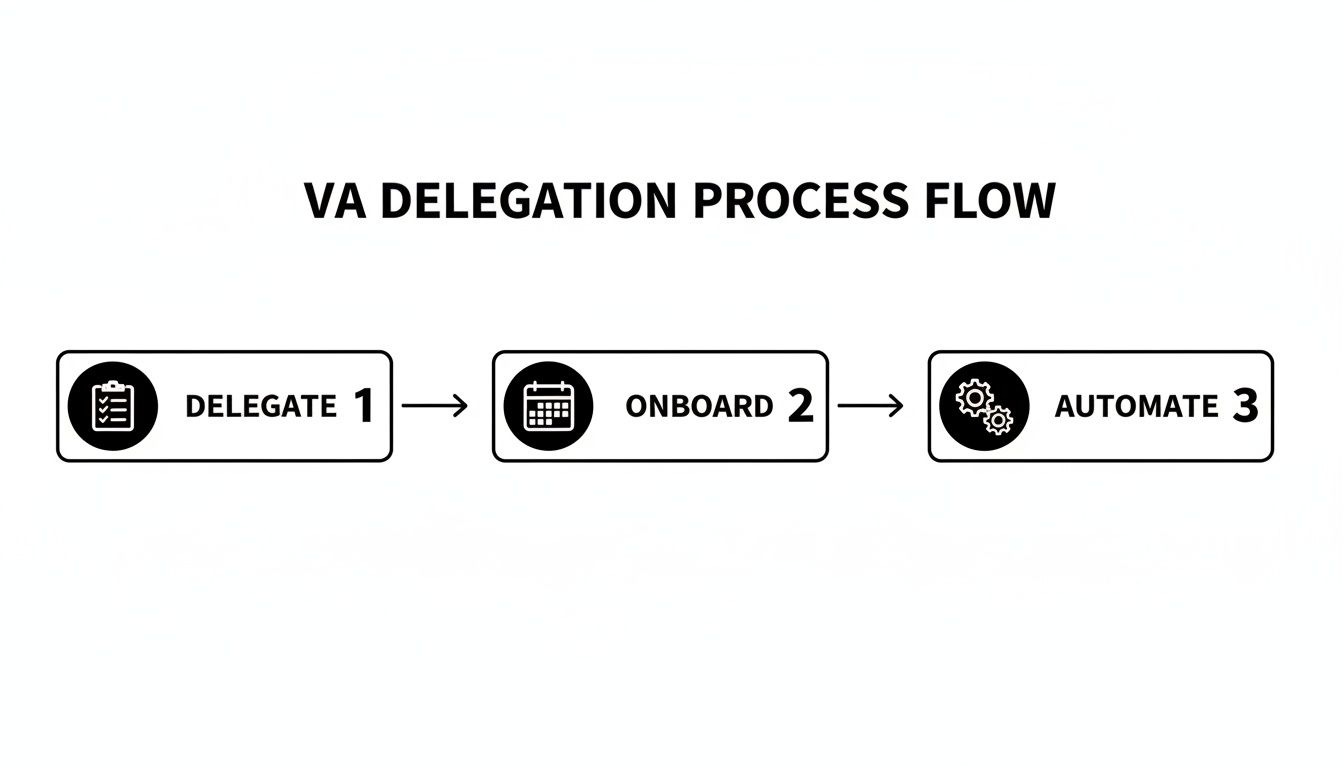
A successful VA partnership is built on a clear, repeatable process, not hope. This playbook removes the guesswork and sets you up for a long-term, productive relationship.
1. Task Selection: Choose Your First 3-5 Wins
Before you hire a virtual assistant, identify 3-5 tasks that are repetitive, time-consuming, and low-risk. Good candidates include managing your calendar, organizing your inbox, booking travel, or updating your Customer Relationship Management (CRM) system. Starting small builds momentum and trust.
2. Task Briefing: Define "Done" Clearly
For every task, create a simple one-page brief. Outline the goal, provide a clear "Definition of Done," list necessary tools, and include examples. This single document prevents miscommunication and ensures you get the expected outcome without endless back-and-forth.
3. Access & Security: Grant Access Safely
Never share your master passwords. Use a password manager like LastPass or 1Password to grant secure, role-based access. Operate on the principle of least privilege—give access only to what is absolutely necessary for the task. Enable 2FA on all critical accounts. A Non-Disclosure Agreement (NDA) is also standard practice to ensure confidentiality.
4. Onboarding Week: Set the Foundation
A structured first week is critical. Don't just send a list of tasks and disappear.
- Week 1: Assign the first 1-2 tasks. Hold a 15-minute daily check-in to answer questions and provide immediate feedback on completed work.
- Week 2: Delegate the remaining initial tasks. Shift daily check-ins to an asynchronous format (e.g., a shared doc or Slack channel) and hold one 30-minute weekly review.
- First 30 Days: By the end of the first month, your VA should manage all initial tasks with minimal oversight. Your role should shift from instructor to reviewer.
5. Cadence & Communication: Establish a Rhythm
Define your communication flow from day one. Decide what requires a live call versus what can be handled asynchronously. A typical effective cadence includes a daily async check-in for updates and a weekly 30-minute sync call for planning and feedback.
6. QA & Feedback: Create a Simple Loop
Implement a straightforward Quality Assurance (QA) process. A shared checklist or task board where you mark items as "Approved" or "Needs Revision" with a brief comment works perfectly. Consistent, constructive feedback is the fastest way for your VA to learn your standards.
7. Scaling the Relationship: From Tasks to Projects
Once your VA masters the initial tasks, start delegating more complex, multi-step projects. This could involve managing a small internal project, creating Standard Operating Procedures (SOPs), or conducting more in-depth research. This gradual scaling turns your VA from a task-doer into a strategic partner.
Delegation Assets (Templates + Scripts)
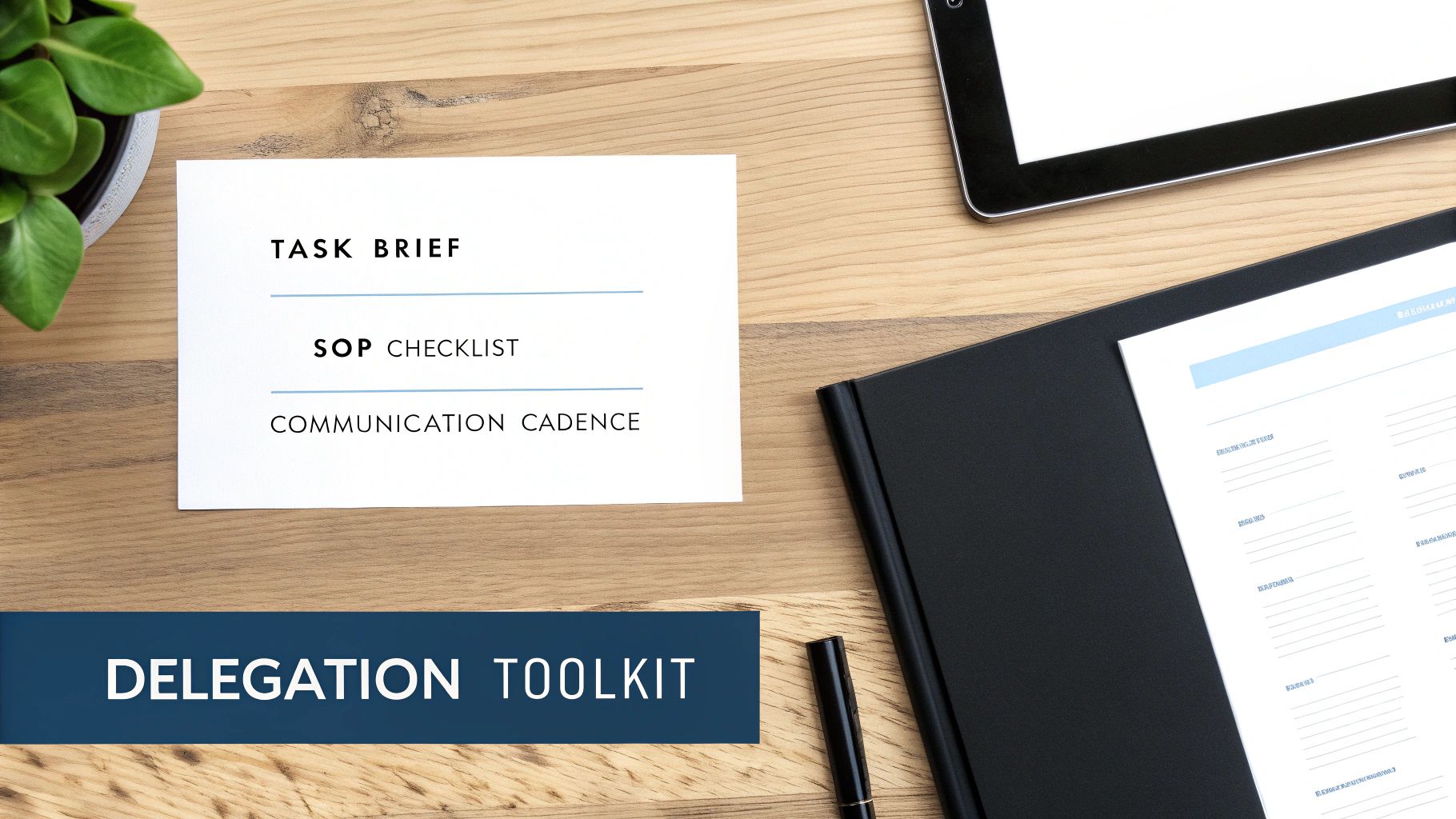
These copy-paste assets are designed to eliminate guesswork and build a solid operational foundation with your outsourced admin support from day one.
Task Brief Template
- Goal: What is the desired outcome? (e.g., "Schedule Q1 planning sessions with all department heads.")
- Definition of Done: What does 100% complete look like? (e.g., "All 5 meetings are confirmed on my calendar with agendas and video links attached.")
- Inputs/Links: Provide all necessary information. (e.g., "Link to contact list, draft agenda, my availability.")
- Tools: What software is needed? (e.g., Google Calendar, Slack, Asana).
- Constraints: What are the rules? (e.g., "Book meetings between 10 AM and 4 PM; avoid Fridays.")
- Examples: Show a finished example. (e.g., "Link to a similar meeting invitation from last quarter.")
- Deadline: When is this due?
- Escalation Rules: Who should they ask if they get stuck?
SOP / Checklist Template
Task: Weekly Social Media Scheduling
- Open the content calendar in our project management tool.
- Review approved posts for the upcoming week.
- Log in to our social media scheduler (Buffer or Hootsuite).
- Draft each post, using the approved copy and images.
- Tag relevant accounts as noted.
- Schedule posts according to the timing guide.
- Mark the task as "Scheduled for Review" in our tool and tag me.
- Await final approval before setting posts to go live.
Communication Cadence Template
- Daily Async Check-In (via Slack):
- VA provides by 9 AM your time: "Morning! Here are my top 3 priorities for today."
- VA provides by 5 PM your time: "End-of-day summary: here's what was completed and any blockers."
- Weekly Sync (30-minute video call):
- Review last week’s progress and wins.
- Align on priorities for the upcoming week.
- Discuss any process improvements or challenges.
- Open Q&A for clarification.
"What to Delegate" Task List
Administrative & Scheduling:
- Manage my calendar and appointments
- Filter my inbox and flag priority emails
- Book travel arrangements (flights, hotels, cars)
- Handle expense reporting and organize receipts
- Prepare and format meeting agendas and minutes
- Transcribe audio from meetings or calls
- Manage online file organization (Google Drive/Dropbox)
Data & Research:
- Conduct competitor or market research
- Build targeted lead lists
- Update and clean our CRM data
- Perform data entry into spreadsheets or databases
- Compile information for weekly reports
Content & Marketing:
- Schedule social media posts
- Format and publish blog posts in WordPress
- Create simple graphics in Canva for social media
- Monitor social media for brand mentions and comments
- Prepare and send out email newsletters using a template
Personal & Miscellaneous:
- Make restaurant reservations and personal appointments
- Order gifts or supplies online
- Follow up on unpaid invoices
- Post job descriptions and filter initial applicants
Measurement & ROI
Effective delegation requires measurement. Tracking key metrics turns your VA from an expense into a strategic investment, providing clear data on their impact.
Suggested KPIs
- Hours Saved/Week: The most critical metric. How much time are you getting back?
- Task Turnaround Time: How long from assignment to completion?
- % Tasks Done Without Rework: A measure of quality and how well your SOPs are working.
- Backlog Size: Is your list of nagging admin tasks shrinking?
- Time-to-Independence: How quickly does your VA master new tasks with minimal oversight?
A Simple ROI Framing
Calculate the return on your investment with this simple formula:
(Hours Saved Per Week × Your Hourly Value) – Weekly VA Cost = Net Value Gained
For example, a [Founder] at a [SaaS] company in [City] might value their time at $200/hour. If a VA saves them 10 hours a week, that's $2,000 in reclaimed capacity. This reframes the cost as an investment in high-value output.
30-Day Scorecard Checklist
At the end of the first month, ask yourself these questions:
- Did I get at least 5 hours back this week?
- Is my VA handling all initial tasks with minimal supervision?
- Is our communication rhythm effective and efficient?
- Do I feel less bogged down by administrative work?
- Was I able to spend more time on strategic priorities?
- Do I trust my VA to handle their responsibilities reliably?
FAQs
Here are concise answers to the most common questions from busy professionals considering outsourcing.
1. What tasks should I delegate first?
Start with 3–5 high-frequency, low-risk tasks to build trust and momentum. Excellent starting points are calendar management, inbox filtering, data entry, and travel coordination. These provide quick wins and allow your VA to learn your preferences in a low-stakes environment.
2. How do I give access securely?
Never share your primary passwords. Use a password manager like LastPass to grant secure, role-based access. Always enable 2FA and operate on the principle of least privilege, giving access only to what is essential.
3. What’s the difference between a virtual assistant and an executive assistant?
A virtual assistant (VA) typically handles a broader range of administrative or technical tasks, often for multiple clients. A remote executive assistant (EA) works in a dedicated, strategic partnership with one leader, anticipating needs and managing complex priorities. The right fit depends on your need for task-based support versus a strategic partner.
4. Dedicated VA vs. pooled team—what’s better?
A pooled team can be good for 24/7 coverage of simple, repetitive tasks. However, a dedicated VA is superior for most professionals because they build institutional knowledge about you and your business. This continuity allows them to work more proactively and handle higher-level tasks, which is the model we use at Match My Assistant.
5. How does onboarding work and how long does it take?
A structured onboarding takes 1-2 weeks. Week one focuses on alignment and delegating the first few core tasks with daily check-ins. By the end of the first 30 days, your VA should be handling their primary responsibilities with minimal oversight.
6. What happens if my assistant is unavailable?
This is a key advantage of working with a virtual assistant agency. Unlike a freelancer who leaves you stranded, we provide backup support. If your dedicated assistant is on vacation or sick, a trained backup can step in to ensure your workflow continues uninterrupted, which is part of our satisfaction guarantee.
7. Is a VA better than hiring in-house for my situation?
For most small businesses and founders, a managed virtual assistant is more flexible and cost-effective. You get specialized support without the overhead of a full-time employee (salary, benefits, payroll tax). It's the ideal way to scale support up or down based on your business needs.
Ready to reclaim your focus and delegate with confidence? Our matching process connects you with vetted, reliable support tailored to your needs. Talk to our team to request a quote and discover our flexible support options.